| Spring 1864 - A Line Drawn in the Sand . . . |

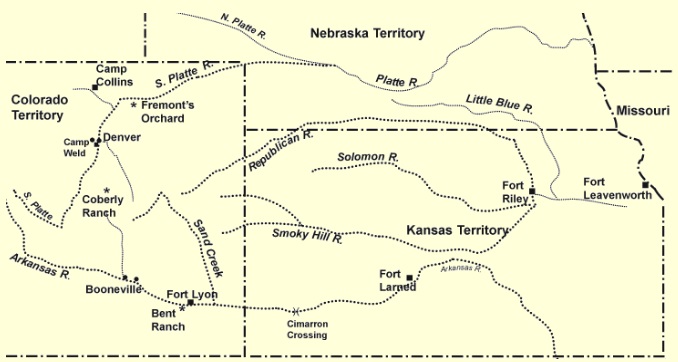
March 1864 – Black Kettle, White Antelope and other elder Southern Cheyenne peace chiefs meet with Agent Colley at Fort Larned, KS. As hostilities between Indians and whites are expected to fully erupt in the spring and summer months, the peaceably inclined Cheyenne chiefs want to move their followers away from the war. Black Kettle warns Colley of the Sioux and Dog Soldier war campaigns planned for the Platte and Arkansas rivers in the summer. Colley passes the information on to Governor Evans, but because Evans was shunned by the Cheyennes leadership last fall, he has little interest in considering Black Kettle’s claim that some Cheyennes and Arapahos do not want to go to war with the whites. April 1864 – Texas rebels near the southeastern borders of Colorado force Chivington to send most of the Colorado 1st Cavalry toward Fort Lyon, leaving Denver City with only a few hundred troops for protection. Although Chivington is concerned about Denver’s vulnerability to Indian raids on the city, he must obey orders from General Samuel R. Curtis to maintain a strong defense of the Arkansas River route. Chivington advises Governor Evans to lobby Washington for authorization and funds to raise a new regiment for the purpose of protecting Denver and the northern settlements and trails. Chivington also wires a request to Curtis, urging the General to lobby the War Department for a new Colorado regiment. April 5, 1864 – Cheyenne warriors steal cattle owned by government contractors, grazing in open land around northern boundary of the Sand Creek reservation. Colonel Chivington dispatches Lieutenant George S. Eayre to pursue the thieves, with 54 troops from the Colorado 1st Cavalry and two mountain howitzers. April 11, 1864 – W. D. Ripley reports that Indians tore down telegraph lines, stole livestock, and drove whites from their homes along Bijou Creek, north of Denver. Chivington dispatches troops from Denver to investigate the cattle thefts. Lieutenant Clark Dunn takes 40 men of the Colorado 1st Cavalry to Camp Sanborn on the Platte River. Ripley guides them to scene of Indian depredations. April 12, 1864 – Incident at Fremont’s Orchard – Recognized as the beginning of major warfare between whites and Cheyennes. Lt. Dunn’s troops encounter 25 Cheyenne Dog Soldiers, led by Little Chief, herding mules (between one and four, depending on who tells the story) across Bijou Creek near Fremont’s Orchard, north of Denver. U.S. Army reports of what happened next are in direct conflict with Indian accounts. Soldiers claim the Indians acknowledged the stolen mules and lined up to fight. Indians claim they found the mules and wanted a reward for their return. The only mutually acknowledged fact is that a fight broke out when the soldiers attempted to take the livestock and disarm the warriors. Who fired the first shot is disputed, but two soldiers are killed and two wounded in the battle. Dunn reports that eight to ten Indians are killed, but the Cheyennes claim only three died. No matter the circumstances, or who initiated the hostilities at Fremont’s Orchard, both Union soldiers and Cheyenne Dog Soldiers have been spoiling for a fight for many years. Both sides are about to get more than they bargained for, and many innocent whites and Indians will suffer. April 13 – May 10, 1864 – A month-long series of skirmishes occur. Northern Cheyenne war parties raid several settlements, as Lt. Dunn’s command sweep the area in search of the perpetrators. Chivington sends Major Jacob Downing to Camp Sanborn to coordinate operations, and to see that the guilty warriors are “appropriately chastised for their outlawry.” Chivington issues similar orders to a detachment from Camp Collins, instructing the commander to find the hostile Cheyennes. “Be sure you have the right ones,” Chivington cautioned, “and then kill them.” (The War of the Rebellion: A Compilation of the Official Records of the Union and Confederate Armies, Series I, Vol. XXXIV, Part III, p.151) During the same time period, Lt. Eayer’s troops search for the war party that stole government stock near the headwaters of Sand Creek. Although Indian scouts manage to stay ahead of the soldiers and warn Indian camps of the enemy’s approach, four Cheyenne camps are looted and burned. April 22, 1864 - Eayer returns to Denver to replenish his supplies and stock, reporting to Chivington rumors of a large band of Dog Soldiers camped 200 miles east on the Republican River. Eayer mounts 80 soldiers and sets out for Kansas with orders from Chivington to root out and kill the Cheyennes’ elite fighting force. May 1, 1864 – Eayer sends dispatch to Chivington, stating that he is on the trail of Dog Soldiers near Smoky Hill fork. May 3-10, 1864 – Major Jacob Downing leads two campaigns against Northern Cheyennes on the S. Platte River, killing 25 and wounding 40 at Cedar Bluffs, and looting and burning an abandoned Dog Soldier village near Moore’s Ranch. Downing reports to Chivington that a full-scale war is under way, and that the Cheyennes must be “exterminated.” May 9, 1864 – Chivington sends Major Wynkoop from Denver to take command of Fort Lyon; sends Anthony to Fort Larned. Captain Silas Soule will join Wynkoop at Lyon as second in command of the fort. Among Wynkoop’s major duties will be to provide protection of the Arkansas from Confederate forces moving up from Texas. Wynkoop must also improve the deteriorating conditions of the fort and the waning morale of the soldiers there. He and Soule will also investigate continued allegations by William Bent that Agent Colley and U.S. Interpreter John Smith are profiteering with Indian annuities. These illegal activities are exacerbating the hostile attitude of Cheyennes and Arapahos already convinced that the 1861 Treaty of Fort Wise was a government swindle. May 13-16, 1864 – Four white settlements in western Kansas are looted and burned by Cheyenne Dog Soldiers. Approximately $5,000 in livestock, property and provisions stolen or destroyed. May 16, 1864 – Eayer’s troops have tracked Dog Soldiers south of the Smoky Hill River, where they are camped near Southern Cheyennes led by Black Kettle and White Antelope. A battle ensues, and again, official army reports of the fight contradict Indian accounts. Both sides agree that Eayer’s troops and the Dog Soldiers formed a line of battle. Dog Soldier Chief Lean Bear (sometimes called Starving Bear) rode out with another warrior, apparently to parley with Eayer. Lean Bear and his companion were immediately shot and killed by order of Eayer, and a running battle commenced. Eayer’s troops were far too small in number to fight the larger Dog Soldier force, and the troops retreated in the direction of Fort Larned to acquire reinforcements. The warriors gave chase for a short time, but according to Indian accounts, Black Kettle intervened and prevented the Dogmen from following the soldiers into a larger battle at the fort. Although the fight ends here, Black Kettle’s efforts to keep the peace with the whites will have no further influence on the Dogmen, who claim that Lean Bear intended to reconcile matters with the soldiers that shot him. The Dogmen will offer the war pipe to warrior clans of the Sioux, Arapahos, Comanches, Kiowas and Apache. Whether the previous rumors of an Indian confederation were true or not, the military societies of all six Plains tribes may now unite in war against all white settlers. May 17, 1864 – Cheyenne Dog Soldiers and Sioux warriors attack Rath ranch, 35 miles east of Fort Larned, KS, and steal all the livestock. Rancher named Walker killed at Cow Creek ranch between Forts Larned and Riley; warriors attack and burn several other ranches in the Cow Creek area. Rancher at Walnut Creek Station survives warrior attack, but his Cheyenne wife is kidnapped. He reports that the Dogmen and Sioux warned him that Cheyennes and Sioux have declared war on all whites. May 19-20, 1864 – Denver Flood - Heavy spring rains send a raging wall of water down Cherry Creek in the middle of the night. Twelve are killed, hundreds lose their homes, and Denver City suffers nearly $1 million in damage, putting further financial hardship on the white settlers in the region. May 23, 1864 – Eayer has not been heard from since dispatch of May 1. Rumors filter in that he and his entire command have been killed. Chivington orders Wynkoop to send a scouting party from Fort Lyon to search for Eayer. Days later, however, Chivington finally receives word from Eayer that the army has struck a decisive blow against the Dog Soldiers. The two-month campaign resulted in the burning of four Cheyenne villages, with several dozen Cheyennes killed, including one of only two Dog Soldier chiefs willing to make peace with the whites. Lean Bear’s brother, Bull Bear, now wavers between his brother’s pledge of peace to President Lincoln, and his anger over Eayer’s attack. May 26, 1864 – 22 Texas rebels, led by escaped murderer Jim Reynolds, attack and rob wagon train at Cimarron Crossing, east of Fort Lyon on the Arkansas River. Originally hired by the Confederate Army to infiltrate Kansas and recruit whites and Indians to fight for the south, the Reynolds Gang’s allegiance to the rebels quickly waned in favor of plundering both settlers and Indians alike. Wynkoop sends scouts to search for the gang, but Reynolds and the boys have retreated back to Texas. May 28, 1864 – The growing fights in western Kansas prompt Governor Evans to ask General Curtis to call all Colorado troops back to Denver. Evans tells Curtis that the warning he issued last fall of a confederation of Indian tribes against the whites is beginning. May 29, 1864 – Evans receives letter from a settler at Booneville, west of Fort Lyon, requesting protection from Indian raiding parties passing west to fight Ute war parties.
been grossly abused, cattle killed, farmers driven from their lands, and fear and danger have run riot.” (The War of the Rebellion: A Compilation of the Official Records of the Union and Confederate Armies, Series I, Vol. XXXIV, Part IV, p. 206-207.) can't comply, for he is bound by orders to keep the majority of his Colorado troops in Kansas. May 31, 1864 – As Major Wynkoop continues to fortify Fort Lyon, he has requested clear instructions from Chivington regarding the army’s policy regarding the numerous Indian tribes in the vicinity. Chivington replies:
vicinity, kill them, as that is the only way.” (The War of the Rebellion: A Compilation of the Official Records of the Union and Confederate Armies,Series I, Vol. XXXIV, Part III, p. 531-32 and Series I, Vol. XXXIV, Part IV, p. 151.) |

| 9.11.01 We'll never forget |
| Spring 1864 Incident at Fremont's Orchard Skirmishes in Eastern Colorado Dogman Chief Lean Bear killed Retribution for Lean Bear's death Confederate insurgency and the Reynolds Gang |

| Home | Sand Creek Massacre | Sand Creek Timeline | Sand Creek Bibliography | Sand Creek Documents | Sand Creek Links | Book Store | Contact |
| NEW! Sand Creek & Western History Book Store Take me there! |
| Sand Creek also available at: |
| D.C. Oakes Family Friend & Foe |
| The Sand Creek Massacre |
| Gunfighters, Highwaymen, and Vigilantes: Violence on the Frontier |
| Black Kettle |